Endometriosis Specialist UK

Endometriosis Specialist UK

Evidence-based quick answer

What is endometriosis and how is it assessed?

Endometriosis is a long-term condition in which tissue similar to the lining of the womb grows elsewhere in the body, commonly around the ovaries, fallopian tubes and pelvis. Symptoms can include severe period pain, pelvic pain, pain during or after sex, bowel or bladder symptoms, tiredness and difficulty becoming pregnant. Assessment begins with a detailed symptom history and may include examination, ultrasound or MRI. NICE advises that a normal examination or ultrasound does not rule out endometriosis; referral or laparoscopy may still be considered when symptoms persist. Treatment is individual and may include pain relief, hormonal treatment, surgery and fertility support. A consultation should consider symptoms, daily-life impact, priorities and pregnancy plans. Keeping a pain and symptom diary can make patterns clearer and help a clinician understand how symptoms affect work, study, relationships and daily activities.

What is Endometriosis?

Definition: Endometriosis is a long-term condition in which tissue similar to the lining of the womb grows elsewhere in the body. It commonly affects areas around the ovaries, fallopian tubes and pelvis, and can sometimes involve the bladder or bowel.

How can endometriosis cause symptoms?

Endometriosis tissue responds to hormonal changes and can be associated with inflammation, scarring and adhesions. Symptoms vary between people and may include period-related pain, persistent pelvic pain, pain during or after sex, bowel or bladder symptoms, fatigue and difficulty becoming pregnant.

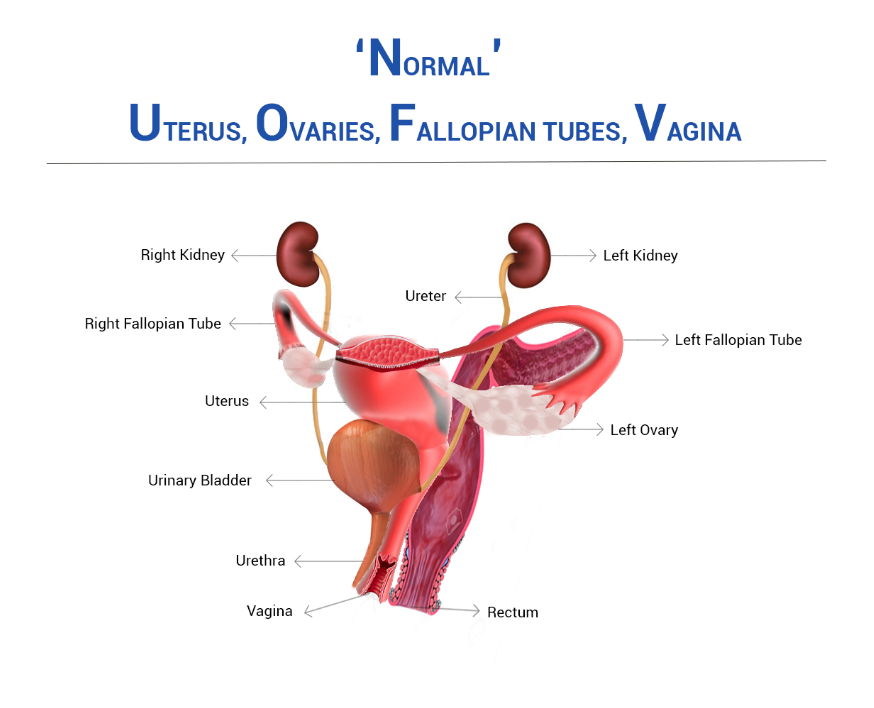
Normal uterus, ovaries, fallopian tubes, vagina

Normal Anatomy

Normal uterus, ovaries, fallopian tubes & vagina

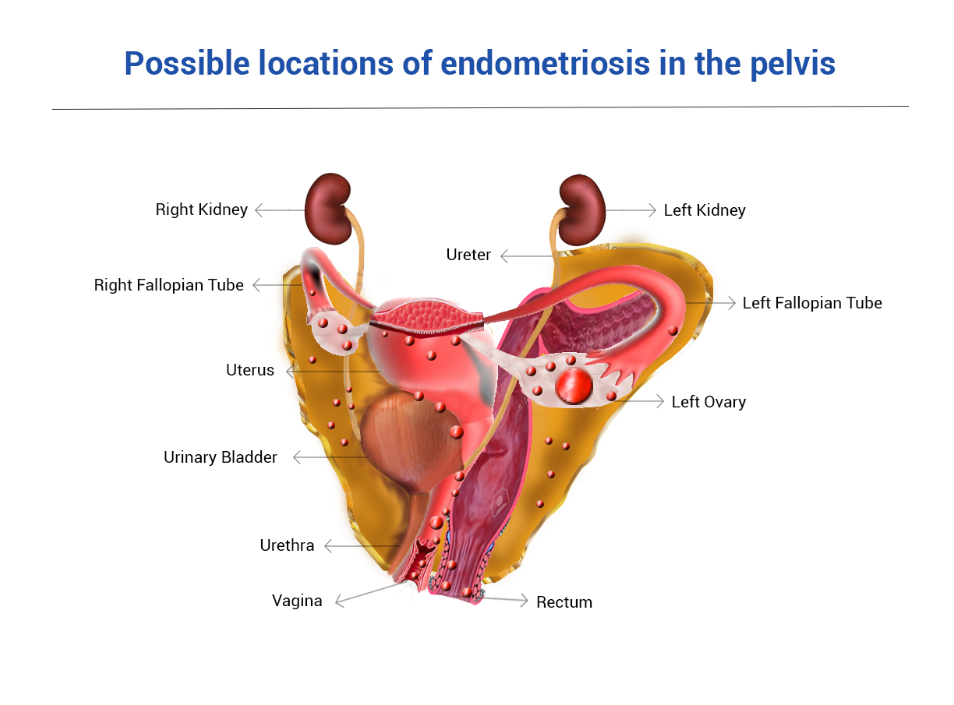
Possible locations of endometriosis in the pelvis

Endometriosis Locations

Possible locations of endometriosis in the pelvis

Endometriosis has TWO main symptoms :

1. Pain

  • The most common symptom of endometriosis is “The Pain” in the pelvic area. For many women, the pain of endometriosis can unfortunately be so severe and debilitating that it seriously affects their normal daily life, such that women may not be able to carry out their normal day-to-day activities.
  • At the beginning of this disease, the pain comes only at the time of the menstrual cycle.
  • As the disease becomes more serious (progressive), this severe pain stays with the woman many days before and after her menstrual cycle.
  • This pain can also be felt:
    • during ovulation (middle of the menstrual cycle)
    • when passing stool (sometimes with blood in stool)
    • when passing urine (sometimes with blood in urine)
    • during or after sexual intercourse (sometimes with blood)
    • in the lower back region

2. Infertility/Sub fertility

  • According to published international studies and research, endometriosis is one of the top three causes of infertility in females.
  • It is estimated that nearly 50 % of women with endometriosis are sub-fertile (reduced fertility/very difficult to get pregnant) or infertile (unable to get pregnant).
  • Furthermore, even if you do get pregnant, long-term endometriosis is known to be associated with poorer pregnancy outcomes such as miscarriage or preterm labour

Endometriosis is a long-term condition. Treatment aims to manage symptoms and may include medicines, surgery and fertility support, depending on the person’s symptoms, priorities and pregnancy plans.

3. Other symptoms may include

  • Diarrhoea or constipation (particularly in relation with menstruation)
  • Abdominal bloating (particularly in relation with menstruation)
  • Heavy or irregular bleeding
  • Feeling tired/lack of energy
  • Recurrent vaginal infections
  • Chemical sensitivities
  • Allergies

Endometriosis affects 200 million women and girls worldwide which means that 1 in 10 women of reproductive age are affected by this disease all over the world. In the Middle East, the incidence is much higher - an average of 1 woman in 8 suffers from this disease. But alarmingly, the incidence in Kuwait is amongst the highest in the world.

  • Kuwait: 1 in 5
  • Kingdom of Saudi Arabia, United Arab Emirates, Bahrain, Qatar: 1 in 8

Endometriosis is not cancer. New, changing or persistent symptoms should still be assessed by a clinician.

Endometriosis is classified into four stages

  • Stage 1: Minimal
  • Stage 2: Mild
  • Stage 3: Moderate
  • Stage 4: Severe

Staging is done depending on location, extent, and depth of endometriosis implants; presence and severity of adhesions; and presence and size of ovarian cysts also called chocolate cysts.

This debilitating disease affects all aspects of a woman’s life.
The girl/woman is constantly in pain, which continues to increase with each menstrual cycle, over months and years. She cannot perform her normal daily activities, either at school, home or at work.
A teenager who is suffering with endometriosis pain is unable to concentrate on her education; she misses school because of pain, she cannot go out with her friends/family and becomes socially isolated.
On the surface she seems all right as there is nothing physically wrong which anyone can see. So her condition is not understood. Her pain is not taken seriously and is just considered to be ‘womanly pain’ and shrugged off.

Unfortunately the vast majority of doctors worldwide are also not trained to identify endometriosis and now it has been proven by research that it can take up to 11 years before a woman is diagnosed with Endometriosis.

When this young girl who is suffering with pain, becomes an adult woman, she still continues to have pain. However this pain has now worsened. It starts many days before her period, is present throughout the time of her periods and continues for many days after her period. So actually she only has 2-3 days in the whole month when she may have less pain ( it is important to remember that she is never pain free ). Every month she goes to the Emergency department of a hospital to get pain killing injections.

Once she gets married, she experiences pain with sexual intercourse and is also unable to get pregnant. These affect her relationship with her husband and family. Pain during or after sex is a recognised symptom and should be discussed sensitively during assessment. She may end up having many incorrect treatments to get pregnant and having many useless operations by untrained doctors who are unable to diagnose or surgically treat her condition.

When fertility is a priority, endometriosis care should be planned with appropriate gynaecology and fertility specialists so options, benefits and risks can be discussed for the individual.

Dr Salma Kayani has been formally trained in England by the Royal College of Obstetricians and Gynaecologists (RCOG) for two-and-a-half years, as a Clinical Fellow, in the medical and laparoscopic surgical treatment of Endometriosis. In addition to the above formal training, she has undertaken a 3 years’ Masters in Science (MSc) Degree with Merit in Advanced Gynaecological Endoscopy from the University of Surrey Post Graduate Medical School (UK).

Dr Salma Kayani is highly skilled and has a vast experience in the medical and laparoscopic surgical treatment of all stages of endometriosis in assessing and treating endometriosis, including laparoscopic surgical options where clinically appropriate.

Till today she has successfully treated hundreds of cases of all grades of endometriosis, nationally and internationally.

Her strength is that she removes all grades of endometriosis through Minimal Access Surgery/Keyhole Surgery. This means that she operates on the patient through a very small 5 mm cut, safely removes all the endometriosis disease and the patient goes home the next day. There is very little blood loss (only a few mls), a small invisible scar and very little pain.

In recognition of her services/contributions towards the medical and surgical treatment of endometriosis, Dr Salma Kayani is the Chair/Captain of Endometriosis of Kuwait nominated by the American Association of Laparoscopic Gynaecologists (AAGL), American College of Obstetricians and Gynaecologists (ACOG) and World Endometriosis Organization.

In May 2014, the Kuwait National Petroleum Company (KNPC) & Health, Safety and Environment Agency (HSE) of Kuwait, jointly, in recognition of Dr Salma Kayani’s skills and services, awarded her with the prestigious 7th Annual Clinical Excellence Award for providing the Best New Service (Advanced Laparoscopic Surgical Treatment for Endometriosis).

Dr Salma Kayani’s relevant training, experience and research are described on the About and Research pages.


Memberships:


Dr.(Mrs) Salma Kayani is an active member of these prestigious international Organizations/Societies for the last 12 years.

  • American association of Gynecological Laparoscopists. - (AAGL)
  • European Society for Gynecology Endoscopy - (ESGE)
  • British Society for Gynecology Endoscopy - (BSGE)
  • British and Irish Association of Robotic Gynecological Surgeons - (BIARGS)
  • Society for Endometriosis and Uterine Disorders - (SEUD)
Advantages to Dr.(Mrs) Salma Kayani Patients:

By being a member of these prestigious socities and organizations, Dr (Mrs) Salma Kayani's patients can have the confidence and assurance that:

  • Dr (Mrs) Salma Kayani's clinical and surgical practice is up-to-date and in accordance with the most latest international medical standards and surgical techniques being practiced in European and American hospitals.
  • The care her patients receive is state of the art, most latest, evidence-based and has support and recognition of these prestigious international societies.

The above medical and surgical practice of Dr Salma Kayani in Endometriosis is backed by extensive research undertaken by her, published in highly recognized international medical journals.

  • S Kayani.Laparoscopic Surgery for Endometriosis. Dissertation for Master’s degree
  • Salma I Kayani, Kent A. Map of Endometriosis, Journal of Minimally Invasive Gynaecology, 18, S75, Nov 2011
  • Salma I Kayani, Kent A. The Kayani-Kent (K-K) Map of Endometriosis. Gynecol Surg, Vol 8, Suppl 1, S1-S225, FC. 02.10, Sept 2011
  • S Kayani, C Robinson, A Cutner, E Saridogan, A Windsor, R Cohen, S Taylor. The Role of MRI Reporting In Severe Rectovaginal Endometriosis. Gynecol Surg, Vol 6, (Suppl 1): page S89, 2009
  • S Kayani, A. Nightingale. Laparoscopic Surgery for Endometriosis- A Systematic Review. Gynecol Surg, Vol 6, (Suppl 1): page S85, 2009
  • Salma I Kayani, Gulumuser C, Cutner A, Saridogan E. Relationship between preoperative symptoms and extent of disease: Comparison of a new classification system for endometriosis with the revised American Society for Reproductive Medicine classification. Gynecol Surg, Vol 5, Suppl 1, S30, FC _27, Oct 2008.
  • Gulumuser C, Salma I Kayani, Cutner A, Saridogan E. Qualitative comparison of postoperative outcomes at 3 and 6 months following laparoscopic surgery for endometriosis amongst two groups of women with good and poor symptomatic correlation with the revised American Society for Reproductive Medicine classification score.Gynecol Surg, Vol 5, Suppl 1, S36, FC _ 45, Oct 2008

Dr.Salma presented the following research in International Meetings in UK, USA and Europe for which she received the nominations and awards:

  • S. Kayani and A. Kent: The Kayani-Kent Map of Endometriosis. Dr Salma Kayani has personally developed a simple yet effective way of mapping endometriosis. Presented as oral presentation at The European Society for Gynaecological Endoscopy (ESGE) 20th Annual Congress, held in London on Sept 21st -24th 2011. Nominated for Raoul Palmers prize (UK)
  • ‘Map of Endometriosis’ oral presentation at the 40th Global Congress on Minimally Invasive Gynaecology (AAGL) meeting in Florida (USA) on 6-10th Nov 2011. Nominated for Carlo Romanini Award for the Best Endometriosis Paper (USA)
  • S Kayani, A. Nightingale. Laparoscopic Surgery for Endometriosis- A Systematic Review.18th Annual Congress of the European Society for Gynaecological Endoscopy, Florence, Italy, Oct 2009
  • S Kayani, C Robinson, A Cutner, E Saridogan, A Windsor, R Cohen, S Taylor. The Role of MRI Reporting In Severe Rectovaginal Endometriosis. . 18th Annual Congress of the European Society for Gynaecological Endoscopy, Florence, Italy, Oct 2009
  • S Kayani, A Windsor, R Cohen, A Cutner. Multidisciplinary team-working in endometriosis centres. British Society for Gynaecological Endoscopy, Annual Scientific Meeting, London, UK 8th - 9th May 2009
  • S Kayani, A Cutner, A Windsor, R Cohen, A Emmanuel. The impact of laparoscopic bowel surgery for endometriosis on bowel function - preliminary report. BSGE Annual Scientific Meeting, London, UK. 8th – 9th May 2009
  • *First Prize:
    Salma I Kayani, Gulumuser C, Cutner A, Saridogan E. Relationship between preoperative symptoms and extent of disease: Comparison of a new classification system for endometriosis with the revised American Society for Reproductive Medicine classification. 17th Annual Congress of the European Society of Gynaecological Endoscopy, Amsterdam, The Netherlands, Oct 2008
  • Gulumuser C, Salma I Kayani, Cutner A, Saridogan E. Qualitative comparison of postoperative outcomes at 3 and 6 months following laparoscopic surgery for endometriosis amongst two groups of women with good and poor symptomatic correlation with the revised American Society for Reproductive Medicine classification score." 17th Annual Congress of the European Society of Gynaecological Endoscopy, Amsterdam, The Netherlands, Oct 2008

There are many myths and misconceptions about endometriosis. Below are some answers to these questions.

How is endometriosis diagnosed?

The only way to diagnose endometriosis 100% is during a laparoscopy, which is a keyhole surgical procedure.
However, a surgeon officially trained in the treatment of endometriosis will be able to “diagnose endometriosis in clinic”, based on patient's history, clinical symptoms and physical examination.

Is there a cure for endometriosis?

A trained expert can treat it in such a way that all the disease can be removed surgically. Therefore symptoms can be controlled and pregnancy can be achieved.

Is endometriosis a sexually transmitted disease or infectious?

No. Endometriosis cannot be passed on from one human being to another. Endometriosis is not an infectious disease.

Is endometriosis inherited?

Yes. Research shows that first-degree relatives (mother, daughter, sister) of a women with this disease have a seven-fold risk of developing endometriosis. If you have endometriosis, please advise your loved-ones to come for a check up for endometriosis too.

Will I be able to have children?

Yes. Once endometriosis has been surgically removed, there are 95% chances that you will achieve natural pregnancy. If pregnancy is a great wish, then please come to see Dr Salma Kayani in her clinic so that together we can develop the best treatment plan for you to help achieve a successful pregnancy.

Will pregnancy cure endometriosis?

No. Some women find that their symptoms of pain are reduced during pregnancy, but this is not the case for everyone. In most cases, endometriosis will return after giving birth and after the mother stops breast-feeding.

Will a hysterectomy cure endometriosis?

As a last resort, some women and their doctors, chose to have a hysterectomy. However, this does not guarantee complete pain relief. Endometriosis can only be treated completely by a surgeon who is formally trained to do endometriosis surgery, laparoscopically.

Is endometriosis cancer?

No. Endometriosis cysts are sometimes referred to as “benign tumours”, because they may “behave similarly” to cancer, but endometriosis is not the same disease. In rare cases, endometriotic implants can lead to cancer. Some research suggests that some women with endometriosis may be at a slightly higher risk of developing certain cancers.