What happens at a private gynaecology consultation?
A private gynaecology consultation is an opportunity to explain symptoms, concerns and priorities in detail. The clinician normally reviews relevant medical, menstrual, pregnancy and family history, current medicines, allergies and previous investigations. An examination may be offered when clinically appropriate and only with consent; you can ask questions or pause at any point. Depending on the concern, the next step may involve blood tests, ultrasound or another investigation, a treatment discussion, or referral to a multidisciplinary service. Bring a medication list, relevant letters, scan reports and a short symptom timeline if available. An appointment request is not emergency care, and no diagnosis or treatment recommendation can be made safely through website content alone. You may wish to write down questions beforehand and ask for clarification about alternatives, expected benefits, important risks, recovery, costs and how results will be communicated.
INTRODUCTION OF DR SALMA KAYANI –GYNAECOLOGY SKILLS
Dr (Mrs) Salma Kayani is a Consultant Obstetrician and Gynaecologist who is a ‘Certified’ Advanced Minimal Access Surgeon in Excisional Benign Gynaecology with a Master’s degree in Advanced Gynaecological Endoscopy with ‘Merit’ from the University of Surrey Post Graduate Medical School (UK).
She has undergone 13 years of continuous, structured, hands-on Royal College of Obstetricians and Gynaecologists (RCOG) certified/approved training. All this training is latest and was undertaken in the top tertiary referral centres of England.
In addition to the above training, Dr Salma is also the author of ‘Standards for Laparoscopic Surgery UK’, in the textbook ‘Models of Care in Women’s Health’ commissioned and published by the Royal College of Obstetricians and Gynaecologists (RCOG). (2009)
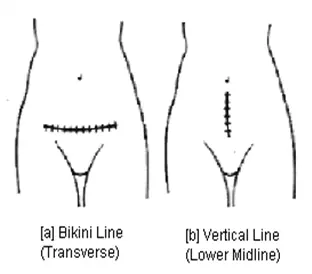
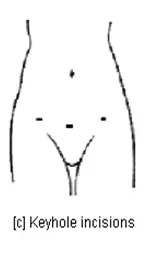
Difference between Open Gynaecology Surgery and Advanced Gynaecological Laparoscopic/Keyhole Surgery
Open Surgery
8-12 inches cut
Big scar on abdomen
Severe trauma and pain
Requires a lot of pain killers for weeks
High risk of infection
Discharge from hospital: 5-7 days
Recovery: 3-6 months
More blood loss (1/2 litre to 2 litres)
Long term risk of severe abdominal adhesions with long-term complications
At present 99.5% of Gynaecologists in the world perform ‘open abdominal surgery’ in Gynaecology.
Dr Salma Kayani is among the very few (0.5%) Advanced Minimal Access Gynaecological Surgeons who performs all her gynaecological procedures through keyhole surgery.
As a Gynaecologist, Dr Salma Kayani is member of the following prestigious International Societies/Organisations:
American Association of Laparoscopic Gynaecologists (AAGL)
European Society of Gynaecological Endoscopy (ESGE)
British Society of Gynaecological Endoscopy (BSGE)
Society of Endometriosis and Uterine Disorders (SEUD)
She is also an invited international speaker and international trainer in Advanced Minimal Access Surgery.
Dr Salma Kayani performs live surgical demonstrations of complex advanced minimal access (key hole) procedures in international conferences and seminars.
Dr (Mrs) Salma Kayani’s advanced gynaecological key-hole surgical skills are backed by the following research papers published in reputable international journals.
S I Kayani, G Pandis, A Cutner. Standards for Laparoscopic Surgery, Chapter 13, for the book ‘Standards in Gynaecology’, Published by RCOG Press at Royal College of Obstetricians and Gynaecologists, 2009,UK
S I Kayani, D J Rowlands. Gasless optical entry at Palmer’s Point in high-risk patient. Gynaecological Surgery, vol 3, Suppl 1, V-36, page S12, Sept 2006
RESEARCH PAPER ON IMPROVED PATIENT CARE IN THEATRE IN MULTIDISCIPLINARY SETTING
Salma I Kayani, Fayez N, Al Rassassy Z. The Buddha Position. Regional Anaesthesia and Pain Medicine, Volume 39, Number 5, Supplement 1, Page E261, ESRA1-0434, Sept-Oct 2014
Salma I Kayani, Al Rassassy Z. The Gravity Slip (G-Slip) – The Ergonomic Way to Positioning of the Unconsious or Semi conscious Patient in Theatre. Journal of Minimally Invasive Gynaecology, 20, S23, Nov 2013